Showing posts with label Veterinarians. Show all posts

Friday, February 13, 2015

Rescued pit bulls fight stigma by guiding people in need!!!

Rescued pit bulls fight stigma by guiding people in need

Feb 11, 4:55 PM EST

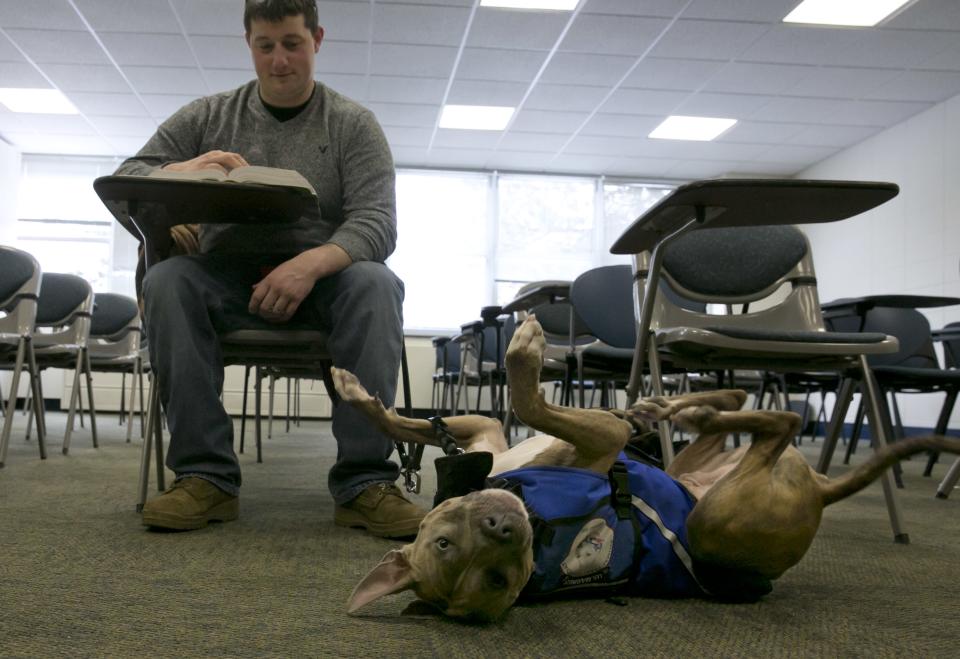
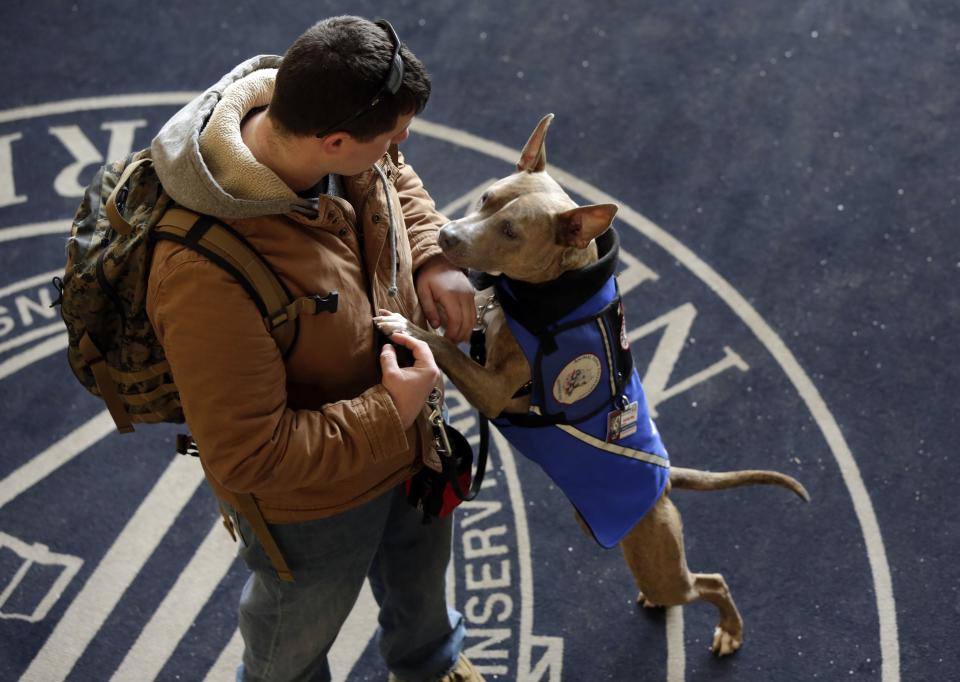
LOS ANGELES (AP) -- When former Marine Joe Bonfiglio starts thrashing in his sleep, his pit bull service dog jumps on the bed, climbs on top of him and wakes him up to end the flashback.

http://news.yahoo.com/rescued-pit-bulls-fight-stigma-guiding-people-174449009.htmlThe dog named Zen has allowed Bonfiglio, 24, who was diagnosed with post-traumatic stress disorder after returning from a five-month tour in Afghanistan, to get back to everyday activities. He can now do things such as shop at malls in Poughkeepsie, New York, because Zen helps calm Bonfiglio when crowds trigger a panic attack.

"I used to go to bars with my friends. And war movies. I am not going to see `American Sniper,'" he said. "It would bring me back to a place I don't want to be."

Pit bulls aren't the typical choice for a service dog. They are feared, banned in hundreds of cities and blamed for sometimes deadly attacks. The Animal Farm Foundation in Dutchess County, New York, wants to change that stigma through a program that trains and donates rescued pit bulls to push wheelchairs or help people regain their mobility and avoid falls.

The effort faces opposition from those who believe the breed is dangerous.

The Assistance Dog Training Program is believed to be the only U.S. training school exclusively for service dogs that uses pit bulls from shelters, said Apryl Lea, the foundation's certified trainer. It's placed five dogs that require two years to socialize, train and acquaint with handlers.
A smaller group, Pits for Patriots, trains rescued pit bulls as comfort, therapy and support dogs for veterans, police officers and firefighters but has yet to place any service dogs. Comfort dogs are pets that get a few weeks of training, while therapy animals receive at least six months of training to help calm people who haven't received a diagnosis as severe as PTSD.

"Veterans and first responders can identify with pit bulls because they either have seen a lot of trauma or been through a lot of trauma," said Kelly Yearwood, co-founder Pits for Patriots in Chicago, whose group started the same year as the Animal Farm Foundation's program, in 2011.

The handful of major training schools and a few smaller ones all typically breed German shepherds, Labradors and golden retrievers for the lengthy, costly process to become a service dog.

Shelters nationwide watch for canine candidates for the foundation's program, which trains dogs based on Americans with Disabilities Act guidelines, Lea said. With pit bull breeds making up a huge percentage of dogs in shelters, she has to carefully decide which dogs are accepted. They must have the right build, aptitude and focus to help a person get through life with disabilities or injuries.

"My job is not just to train the dog but to help the handler be a good trainer, too," she said.
But the program faces pushback.

"There are over 100 dog breeds that are far more suitable to perform tasks for persons with disabilities than pit bulls, especially rescued pit bulls with unknown backgrounds," said Colleen Lynn, founder and president of DogsBite.org, a national group that tracks bites and works to reduce attacks through bans and other laws.
Pit bulls can be unpredictable and kill or maim when they attack, she said.
From 2005 to 2014, dog attacks killed 326 people in the United States, according to data compiled by DogsBite.org, which blames pit bull breeds for 62 percent of the deaths.

"There is simply no need for pit bulls, rescued or otherwise, to be utilized as service dogs for people with disabilities," Lynn said.

Pit bulls have helped people like Bonfiglio get back to their normal lives. The former Marine has made such progress with Zen that he's now taking cybersecurity classes at Mercy College in New York.

"Zen is a fantastic dog; the best thing that's happened to me since I've been home," said Bonfiglio, whose other family dogs also provide comfort. "They are all great supporters. They don't talk back, just put a smile on your face."
----
Online:
- www.animalfarmfoundation.org
- www.pitsforpatriots.org


Source:-http://hosted.ap.org/dynamic/stories/U/US_PETS_PIT_BULL_ASSISTANCE_DOGS?SITE=AP&SECTION=HOME&TEMPLATE=DEFAULT


Tuesday, November 18, 2014

Top 5 Thanksgiving Treats

As you gather around the table this Thanksgiving and give thanks for good food, good friends and even your cranky family members, don’t forget the furry or feathery member of the family — your pet. Of course, a pet doesn’t need a toast in its honor to feel appreciated, but a special treat would probably elicit an extra lick or cuddle from your best four-legged friend. Just remember that the holidays aren’t an excuse to break from tradition and serve your pet chocolate or other foods that might upset its sensitive stomach. However, there are some terrific Thanksgiving treats that are perfectly pet-safe and guaranteed to make your critter feel extra-thankful for such a thoughtful pet parent. Here are just five.

1: Toys

If your pet is on a restricted diet or doesn’t usually handle new food well, pick out a toy that your animal will go gaga for. Consider a squeaky toy shaped like a turkey bone or a carrot. Some retailers carry “pampered pet” lines, in which you’ll find toys shaped like wine bottles or sushi (if turkey and all the fixings isn’t your thing). McCulley recommends interactive toys that dispense treats as a great way to keep your pet occupied while you’re entertaining human guests. By the time your furry friend has gotten all of the kibble out of the toy, you’ll be cleaning off the table and ready to spend the afternoon curled up in a turkey-induced coma with your pet.
Some one-on-one time like this is probably the best treat of all for your pet, but any of these five ideas can also help make sure your pet is a grateful gobbler this Thanksgiving.

2: Biscuits and Other Treats

If you aren’t up for making your own treats or don’t have any leftovers, you can find a large variety of treats available at pet superstores or even your local market that will leave your pet feeling gracious. McCulley says ingredients like pomegranate, acai berry and quinoa, which have been fads in people food for the past few years, are now crossing over into pet treats. Look for items that are made with human-grade ingredients to ensure your furry friend is getting the very best. Many organic treats are made with natural ingredients such as pumpkin, sweet potato, and apple with ginger or cinnamon for a fun Thanksgiving twist.

3:TurkeyTreats

If you like a traditional feast with a big turkey as the main dish, your pet is in luck. There are quite a few ways you can prepare some of your leftover turkey that will be paw-licking good. Be sure to remove any skin and bones and don’t serve your pet any turkey that’s been sitting out longer than two hours to avoid risk of salmonella poisoning. Skinless, boneless turkey is a great treat for most cats and dogs. Cut up a few pieces and add it to your dog’s regular food to give it its own Thanksgiving meal. For cats, try pureeing turkey with sweet potatoes or pumpkin and adding it to their regular food or letting them lick it straight from the spoon. And if you’ve ever wondered what to do with turkey giblets, try boiling them up for a yummy pet treat.

4: Bones and Chews

It might be tempting to toss a turkey bone your dog’s way during the holiday, but according to L.A. Animal Services, turkey bones can easily break, and the sharp splinters could cause damage to your dog’s intestines. If your pooch goes nuts for bones, look for store-bought bones or chews in special Thanksgiving flavors that will be a real treat without the risk. Pet trend expert Janet McCulley recommends turkey-flavored bones, or even organic dog chews made out of sweet potatoes or apples. Make no bones about it, you will be thankful your canine has a yummy Thanksgiving treat without the threat of a visit to the emergency animal hospital.

5: Fruits and Veggies

Not all pets can eat meat, including most pocket pets like gerbils, hamsters, rats and birds. Many people love these small pets, but often overlook them when it comes to holiday treats. Pocket pets can have small treats occasionally, but according to the educational staff at Drs. Foster and Smith, they tend to like treats better than real food, so it’s best to dish them out sparingly. In general, raw vegetables like carrots and broccoli are OK to give a small rodent, so when you’re preparing your Thanksgiving meal, save a few pieces for your pet. Pet birds also love fresh veggies and fruits, including cooked sweet potatoes and cranberries, which are both common staples on many Thanksgiving tables. Cooked vegetables like pumpkins, sweet potatoes, carrots, green beans, and peas are terrific options for cats and dogs, too.


Thursday, October 23, 2014

OBESITY IN DOGS

Definition: Obesity (the storage of excess fat) is usually caused by excessive food intake and insufficient exercise. 

  • Estimates show that 40% to 50% of dogs are overweight and 25% of dogs are obese.
  • Dogs can develop many obesity-related health problems. 
  • By examining your dog, veterinarians determine whether he or she is overweight or obese and help you create a weight-loss program. 
  • The most effective weight-loss plans involve increasing activity and feeding fewer calories. Causes Obesity (the storage of excess fat) is typically caused by excessive food intake and insufficient exercise. 
  •  According to estimates, 40% to 50% of dogs are overweight and 25% are obese. Obesity is more common in older, less active pets. Dogs that are fed homemade meals, table scraps and snacks are more likely to be overweight than dogs eating only a high-quality commercial pet food. 


 Diagnosis and treatment 

There are many obesity-related health problems, and some medical conditions can lead to obesity. So it’s important to take your dog in for annual checkups. Remember, you can’t judge if your dog is overweight merely by putting him or her on a scale. By examining your dog, veterinarians can use weight, overall body condition, and other indicators to tell you whether he or she is overweight or obese, what the probable cause is, and what the best weight-loss regimen is. Don’t feel bad if you are told your dog is too heavy. 

Everyone knows that dieting can be challenging. But losing weight can help your dog live longer, avoid disease and feel better, so it is well worth the effort. Get veterinary advice before changing your dog’s eating and exercise habits. Veterinarians are trained to recommend an appropriate diet and exercise program for safe weight loss. When helping your dog lose weight, slower is safer. “Crash” diets or intense workouts aren’t appropriate for inactive dogs. If your dog gained the weight slowly, he or she can lose it slowly. The most effective weight-loss plans involve increasing activity and feeding fewer calories. The more convenient you make it, the better the chance of sticking with it. When on a weight-loss program, your dog should lose 2% or less of its initial body weight per week. For example, a 100-pound dog should lose no more than 2 pounds every week. A successful weight-loss program may take a year or longer. 


Diet 

There are several dietary strategies for helping your dog lose weight. One or more of the following may be recommended by your veterinary hospital. For all of these methods, it’s important to use an actual measuring cup (not an old coffee mug or drinking cup) to keep track of how much you’re feeding your dog. Feed your dog smaller meals more often. This helps your dog burn more calories and should help minimize begging for food. However, don’t feed more food per day. Instead, divide your dog’s daily ration into three or more feedings. Feed your dog less of its regular food per day. This strategy is most effective with increased activity. But check first with your veterinarian to ensure that your dog will receive the right amount of nutrients. Instead of feeding your dog less, gradually switch him or her to a lower-calorie food recommended by your veterinarian. The change should be gradual; a sudden switch could upset your dog’s stomach. 

Combine the new food with your dog’s usual food in larger and larger proportions over several weeks until you are only providing the new food. Give treats only on special occasions, such as birthdays, holidays, or good visits to the veterinarian. Offer low-calorie treats and limit or eliminate fattening ones. 

Exercise 

You can help your dog become more active and lose weight by scheduling regular play times and walks. Consult your veterinarian before beginning an exercise program for your dog. Not all games/exercise are appropriate for all breeds or medical conditions. For walks, start out slowly to give your dog a chance to adapt to an exercise routine. Work up to a brisk 10- to 20-minute walk or jog once or twice a day. On hot or cold days, go easy or rest. If you don’t have time to walk your dog, hire a dog walker. Doggy day care centers can also help ensure that your dog gets plenty of exercise throughout the day. Here are some calorie-burning activities for your dog: 

· Fetch 
· Keep away 
· Playing with other pets 
· Walking or jogging 
· Running off leash in a restricted area 
· Swimming (great for arthritic dogs) 
· Tricks for low-calorie treats 
· Tug of war 


SOURCE: https://www.aaha.org/pet_owner/pet_health_library/dog_care/diseases_conditions/obesity.aspx


Friday, October 17, 2014

Team Member of the Month- Liz


Our Team Member of the Month for October certainly keeps busy.  

Having worked at the HAH for nearly 4 years, Liz has experience in all departments.  For the last year, she has been the technician for our board eligible surgeon; therefore keeping very busy with critical and advance surgical patients.  Liz never shies away from offering a helping hand within the practice. She welcomes new processes and happily shares her knowledge with the team. 

Liz is currently completing her 2nd Bachelors degree in pursuit of her career goal as a veterinarian. She is a regular participant in our community events like the Stonewall Pride Parade in Wilton Manors and the Pit-bull BBQ Event this November. Yet, she still finds time to participates in more personal events like the Leukemia & Lymphoma Society Light the NightWalk a cause close to her heart because of her mother’s diagnosed 2 years ago.

By the end of the month it may feel a little like ‘all Liz all the time’ as you see her with our Patient of the Month and we share some highlights of her talents but the fact of the matter is that Liz is a hard worker!  The HAH is very proud to partnered with Liz in the care of our patients and recognize her as our October Team Member of the Month!!!

Tuesday, August 19, 2014

Back to School Separation Anxiety

With all the excitement of the kids going back to school, many families may not think about what it means to the dog or cat. What you may notice are changes in behavior, a sad dog or cat, who mopes around or sleeps a lot more. Or your dog may suddenly started chewing things he shouldn't, or your cat does a lot more meowing. And you may not even connect the unusual cat or dog behavior with back-to-school time. Dogs and cats love routine, it makes them feel secure. They like knowing that certain things happen at about the same time each day, and they know where they want to be when it happens. If the kids have been around all summer, playing outside with the dog, or giving kitty extra love and snuggles, and suddenly they’re gone all day, it's upsetting. For some pets, they just feel sad and confused, and others feel real separation anxiety and may act up. 


 Kids can help your pet through the back-to-school blues The first thing to note is that this is a family matter, and a good opportunity for the kids to take more responsibility for the care of their pets. Let your kids know that their dog or cat is going to miss them when they're gone all day, and discuss what they can do to help their pets through it. One of the best ways for a pet to get over the loss of one routine is to replace it with another. Your pet may be sad all day at first, but if he knows that at 3:45 your kids will be home from school and will actively play with him soon after each day, your pet has something new to look forward to. If your child has a set time to do homework or read, that's an excellent time for the dog or cat to curl up next to her and "help" with studying. Ask your kids to think of other ways to include their pets in their routines. 


More than just sad, it’s separation anxiety If your pet exhibits true separation anxiety, as in, he goes crazy when he sees your kids put on their backpacks to leave for school, or is destructive when everyone is gone, you'll have to do some gentle training to ease his stress. Your kids may feel sorry for their pet and do a long sad goodbye. This only reinforces your pet’s fears and builds up the anxiety. It’s better to make the goodbye upbeat and brief, or eliminate it completely. Depending on your pet, he may respond well to a goodbye petting, a little goodbye treat, or simply leaving with a cheerful "good boy!" as your kids go out the door. This should happen before your pet gets upset. If your pet is freaking out, absolutely do not reward with anything. If you can't get your pet to calm down if it’s a dog, a simple "sit!" command may help. Then reward with petting and telling him he's ok once he’s calm. If your pet gets upset just by the backpacks or car keys being picked up, pick those items up and walk around the house with them several times a day, but don't leave. Your pet will learn not to associate those items with the pending doom of your kids leaving.


When back-to-school means an empty house If everyone is gone all day, both parents included, your pets are going to be bored on top of being upset. It's important to leave them some interactive toys to help them pass the time. Eventually, they will get used to the new reality, and will likely sleep most of the day. You can balance the boredom by providing vigorous exercise each day when you or your kids are home. Remember, you and your kids may have had a very busy day, but your pet has done virtually nothing, unless there is evidence to the contrary, as in a shredded or chewed up sofa. Providing your dog or cat active, vigorous play each day will help them burn up their pent up energy. Take your dog for a run or go outside and throw a ball or flying disk. For your cat, run around the house with a little toy on the end of a string. You may also want to consider getting your pet a little buddy to keep him company when no one is home. Even an aloof adult cat is likely to accept a kitten into her life, and the kitten will entice the older cat to play. And dogs, being true social animals, nearly always accept another dog to play with. Remember, your pets can get nervous, upset, anxious or lonely just like people, only they don't have the benefit of knowing that you’ll be back when you leave. It's up to you and your kids to make your pets feel secure in ways they understand. 

Source: http://www.petcentric.com/08-24-2009/your-pets-view-of-kids-going-back-to-school


Tuesday, July 29, 2014

Car Sickness In Pets

Does your dog throw up in the car when you go for rides? He may be experiencing typical motion sickness, just like some people do. Motion sickness usually begins very shortly after starting the car ride. The dog will begin to drool and then vomit. It’s not serious, but certainly not something that we like to clean up! 

To solve the problem, first try acclimating the dog to car rides. Do this by simply putting him in the car for a few minutes each day without going anywhere. Then try just going down the driveway and back, and the next day going around the block. Gradually build up the distance and time the dog rides in the car. 


Sometimes this will help to decrease the dog’s anxiety over riding in the car and may help to decrease vomiting. If that doesn't work, there are some over-the-counter medications you can try. The medication will need to be given about an hour before the car ride. Ask your veterinarian for a recommendation as to what drug to try and the dosage for your pet.

(Never give any medications to your pet without your veterinarian’s advice!) These drugs are safe, with drowsiness usually the only major side effect. But since your dog isn't driving the car, that shouldn't be a problem! If over-the-counter drugs don’t work, your veterinarian may be able to suggest another method for curing the car sickness.


Friday, July 11, 2014

July Patient of the Month- Magic!!!


July’s patient of the month could arguable be a story of real magic. This 6year old, 19 pound, Miniature Poodle spent 17 days in our hospital under the primary care of Dr. Carlos. This determined little guy inspired our team of doctors and technicians that worked day and night with emergency, critical and ultimately supportive care to ensure he returned home.

“Magic”, as he is so appropriately named, was referred by his regular veterinarian to our hospital after 3 days inappetance, lethargy, no bowel movements and a severe case of anemia of unknown origin.

Anemia is defined as a decreased number of red cells (RBCs) in the blood, due to loss of, destruction of or lack of production of the RBCs.  Future diagnostics would tell us that the cause of Magic’s anemia was a bleeding mass in his stomach.  But the challenge here was that the mass was not obvious on radiographs due to the presence of foreign material that Magic had ingested. Therefore the first two days of hospitalization were dedicated to stabilization and treatment of the anemia.  This treatment included fluids, immune suppressive medications and two separate blood transfusions from our in-house blood bank. By the beginning of his second day of treatment Magic was feeling better. Radiographs were repeated and the source of all his problems became clear. When the foreign material had passed through his stomach a sizable mass was clearly visible. 

Surgery was performed by Dr. Carlos and Dr. Bibevski that afternoon. In surgery they found the mass originating from the wall of the stomach.  The mass and a large portion of the stomach were removed.  While recovery from surgery was uneventful however, he was not out of the woods yet.

In the days that followed surgery, Magic developed symptoms expected from the removal of such a large portion of his stomach. These symptoms included vomiting, inappetance and lethargy which would wax and wane throughout his recovery. A Nasal Gastric tube was placed to help remove the buildup of bile in his stomach and alleviate his chronic vomiting. Intravenous fluids were administered to maintain hydration.

Warming up after a bath- getting ready to go home!!
Once food was reintroduced to Magic’s diet he acquired a severe case of pancreatitis. Pancreatitis is the inflammation and swelling of the pancreas. Pancreatitis can be caused by many things but is characterized by the abrupt onset of vomiting and severe pain in the abdomen. It is confirmed by blood tests showing elevated pancreatic enzymes- i.e.-amylase and/or lipase levels. Treatments involve gastric acid reducers, anti-emetics and complete rest of the pancreas by administering nothing by mouth for several days.

Magic started to show signs of improvement. He began to keep small amount of food down and maintain his energy.  Then, Magic again through us a curve ball. In a matter of 24 hours Magic went from nearly going home to critical condition. He was placed in our oxygen chamber and given a plasma transfusion to help his body recover from all the changes occurring in his body.  Each day, each hour even, Dr. Carlos evaluated and adjusted Magic’s care.

Is my Dad here?
The following week was full of ups and downs for our team and for Magic’s family. However, no one gave up. His family visited and discussed all options with Dr. Carlos. This was a trying time for everyone but Magic was a fighter.

On his final day of hospitalization, Magic was able to eat small amounts of food in a slurry and keep it down. His disposition was brighter and he was sent home with strict instruction about his dietary care. His prognosis was optimistic. Today, Magic is well. His entire family participates in his care and he is on his way to returning to his normal diet.

Stories like this and families like this that make the job we get to do every day a joy. Dr. Carlos and the HAH team used all their resources to help Magic return to his life of rest, relaxation and love and we are so pleased to have been a part of his medical team and recognize him as our July Patient of the Month!


Friday, June 13, 2014

June-Patient of the Month-Smokey!!!!


Smokey, a 4year old, Shih Tzu mix was first brought to the HAH for hind limb paralysis.  A resident of the Bahamas, Smokey was diagnosed and treated for neurological deficits with consideration of intervertebral disk disease (IVDD). After being “down” for 12 days, his primary Veterinarian referred him to the HAH for evaluation and possible spinal surgery.  His limping had turned into immobility over a period of one week and the possibility of surgery was real.

Dr. Bibevski, examined Smokey upon arrival. He had minimal sensation in his toes, and was unable to walk. IVDD was probable.

IVDD is a common disease seen in small dogs. The jump from a limping pet to a pet that is completely unable to walk can occur quickly and the compressed spinal cord can cause irreversable damage.

CT scan showing disc compression on the right side.
A Cat Scan was scheduled and performed at the Animal Cancer Care Center for Smokey.  The scan showed two lesions compressing the spine. The more significant of the two lesions was a herniated intervertebral disc that compressed approximately 80% of the spinal cord. IVDD was confirmed and "decompression" surgery was scheduled.

This “decompression” surgery is very delicate and brings no guarantees that when the pressure on the spinal cord is released that the spine will return to its normal function.

During this delicate procedure, Dr. Bibevski removed the herniated disc material. After surgery, Smokey was comfortably maintained to eliminate the possibility that he may further injure his spine. His recovery was very smooth.

Intra-operative photo showing the herniated disk compressing on the spinal cord.
Within one day of surgery, physical rehabilitation therapy began. By day #3  “evidence of independent motor function” was seen. Smokey was on the mend and scheduled for discharge that day.

"I am so grateful to Dr. Bibevski and her team for helping our Smokey. It was a very scary and nerve wrecking experience and thankfully for their great expertise at Hollywood Animal Hospital there was a favorable outcome. His recovery has been nothing short of amazing"
At home, in the care of his owner, Smokey has steadily regained his strength. Today,  he is walking with only a slight indication of any prior injury.

We have cared for many patience with IVDD at the HAH and success stories like this are a testiment not only quality medical care but also to the diligent attention and care of our owner. Smokey was set up for success with his family in his corner. We are very proud to be a part of his medical team and to honor him as our June Patient of the Month!!!


Below are videos of Smokey's home recovery from his initial "sling" walking to near normal cantor.


Thursday, March 6, 2014

March Patient of the Month- Trevi


This month we recognize a patient with a very different story. This 3 ½ year old, male Great Dane has been a patient of the HAH since he was 6 months old and been in the care of Dr. Herrington for all of his wellness needs. However, this month he is not being recognized for his stories written within our hospital rather we would like to recognize him for his adventures outside of these four walls. 

Trevi, full name OHBIS CH Great View's of the Fontana Di Trevi at BWK, CGC, AOM is an award winning show dog that holds the distinction of being Owner Handled. This means that his momma, Amber, is also his handler. Amber and Trevi have been together since he was 8 weeks old and truly have a special connection. They have traveled the country together showing off his skills in obedience, tricks, rally, and agility as well as his more typical “tricks” like playing dead, grabbing a tissue/towel when  Amber sneezes, taking a bow, peek-a-boo and dancing...to name a few. He is a Canine Good Citizen and simply loves to learn and have fun. As does his mom. 

In his career, Trevi has received the 2013, #2 Owner Handler Great Dane in the Country. He was first grand championship major going Best of Breed on the Florida January Circuit beating out 39 other Great Danes and is officially listed in the Top 20 Great Danes in the Country. 

His most recent charge was at the prestigious Westminster Kennel Club just this year where he received an Award of Merit out of an entry of 32 Great Danes! 
 Trevi giving Amber a high five for such a job well done!


Riding around Central Park while in NYC.
“It was an honor just to show [at Westminster]! I was a little nervous but we were also very excited, the most important thing for us is to have a good time while we are out there! Trevi showed like a dream that day! He really gave it his all….This was honestly a dream come true!”

“Saying how proud this boy makes me just isn't enough! He truly is my best friend and it's such a fun adventure and amazing experience traveling around the country with him! We are currently traveling around still showing in Breed & the Owner Handler Series, so hopefully we will have more exciting news to share in the future!”- Amber

Relaxing after a long day traveling.
 Amber and Trevi in Central Park.


Amber and Trevi certainly make a great team and we are pleased to know them and be able to highlight this talented duo.

To view Trevi and Amber at Westminster- check out this link! They are armband #11 at 0:22 seconds.


In the ring at Westminster right after Trevi received his Award of Merit,
 http://www.westminsterkennelclub.org/videos/Breed%20Judging/2014/Working/pid:M_QF0xERT_am


Trevi imitating a Dane statue at the 2012 Great Dane National


They will also be showing March 15 & 16 in Davie at the Bergeron Rodeo Grounds if you want to see them live in actions. It should be an awesome day.
 
 His Owner Handler Best In Show picture.