Friday, September 2, 2016

Anxiety,Your Pet and You!

Anxiety, Your Pet, and You
How to recognize fear and anxiety in your pet and what you can do.
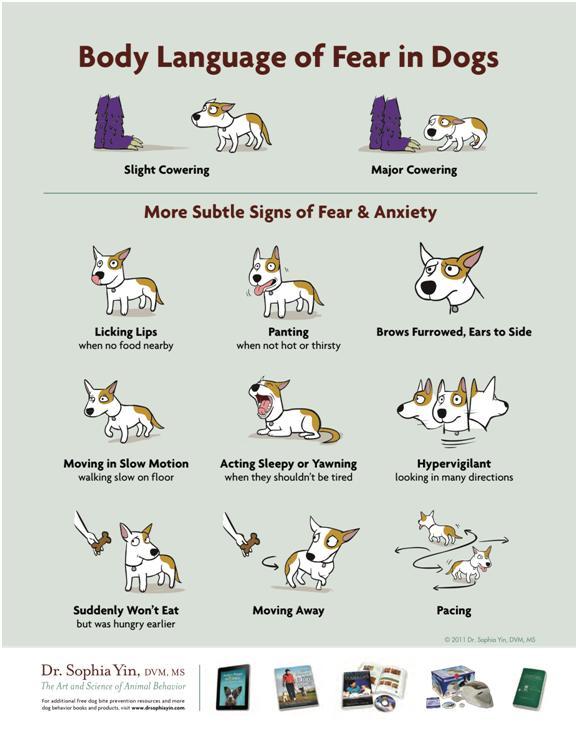
It is important that anyone who spends time around animals, or is a pet parent, to be able to recognize anxiety signs animals may display. Often animals will display signs that they are feeling anxious, or fearful, and those signs will go unnoticed. This lapse results in increased animal aggression, decreased animal welfare, and is detrimental to the human-animal bond. This article will address how to recognise anxiety in your furry friend and steps you can take to ease their anxiety. 

What does anxiety look like? 
Behavioral cues that your pet is afraid, anxious, or stressed range from subtle to obvious. Subtle signs in dogs include salivation, panting, lip-licking, yawning, paw lifting, avoiding eye contact with a stressful situation/object/person, whites of their eyes are often more noticeable, sticking out the tongue, raised hairs on the back, increased activity, changing positions, and keeping a low body position.  Obvious signs in dogs include rolling onto its back, hiding, trembling, vocalizing, urination, defecation, and diarrhea. Cats are often difficult for people to read. Signs in cats include flattened ears, hiding, sitting on all fours with their head held in a low position, eyes wide, pupils dilated, whiskers close to body, tail close to body, increased breathing rate, vocalization, trembling, urination, defecation, spraying, and diarrhea. (1)


What causes it and what can you do? 
Anxiety can be phobic, situational, separation-induced, or general in nature. Long term stress and anxiety in your pet can have negative effects on their health and your bond (2). Do not be afraid to talk to your veterinarian about any behavioural concerns you may have. Addressing anxiety related or behavioural related issues requires multiple approaches. These approaches may include training, environmental changes, human behaviour changes, and medical management. 
Training 
Training steps you can take to manage anxiety include avoidance, desensitization, counter-conditioning, and response substitution. Avoidance involves not putting your pet in a situation they dislike. This method does not address the actual problem. It is impossible to avoid some anxiety producing situations, and there are steps that can be taken to increase your pet’s ability to cope in those situations. 
Desensitization involves getting your pet accustomed to the anxiety-invoking situation. This involves starting your pet with a low level of exposure to anxiety-invoking situation and gradually increasing that exposure. For example, if your pet has a noise-phobia and fear of thunder, keep your pet in a safe positive environment and play a CD of thunder noise at a low level for a short period of time. Reward the dog during this time. Gradually, over time, and multiple sessions, the time of exposure and volume can be increased. 

Counter-conditioning takes an event your pet perceives as negative and associates it with a positive outcome. For example if your pet becomes anxious at the veterinarian’s office. Try going more frequently. Walk into the office, give your pet a treat, then leave. Then progress to walking in and siting down in the waiting room and give your pet a treat. Gradually increase the amount of time in the waiting room. Frequency and repetition is more important than time spent during a given session. It is important that you do not overwhelm your pet in the process of desensitizing them to a scary stimulus.
Flooding is and old school practice that involves overwhelming your pet with a stressful situation until your pet is forced to ‘accept’ the situation. This is not only stressful for your pet, but can lead to learned helpfulness, aggression, and can be detrimental to your bond with your pet (3). Positive reinforcement works far better than negative reinforcement. 
Products and medications 
There are other changes that you can make to help ease anxiety. Pheromones such as Adaptil and Feliway can help create a sense of safety in a home. Pressure wraps such as Thundersirt ® and Anxiety Wrap® have been shown to help anxious dogs during stressful situations (4-7).  Medical options for more intense anxieties or general anxieties include pharmacological treatments such as anti-depressants, sedatives, and anxiolytics. If a medical approach is indicated, your veterinarian can prescribe these medications. Medical management can be used short term or long term depending on what your veterinarian thinks your pet needs. 

Why is recognizing your pet’s behavioral cues is important? Your relationship with your pet and family depend on it. 
Often canine behavioural cues are misinterpreted or missed entirely by humans. Unfortunately, this can result in children, or owners, being bitten or scratched. Here are some scary statistics to stress how important it is to be aware of behavioural cues. In a given year there are around 4.5 million people in the United States bitten by dogs (8) (9). Most of these incidents involved children and were within the home of a known dog (8) (9).  Bites to children often involve the face and neck, usually because this is the part of the body closest to the dog (8) (9). Accidents most often happen when there is limited or no adult supervision (8) (9)
So what does that mean for you? You need to be aware of behavioural cues your pet may be giving that they are uncomfortable and may escalate. Any pet can bite, especially if they are put into an uncomfortable position. If you have children in your home, it is important to teach them how to properly interact with animals and how to read behavioural cues. If they are too young to properly behave around animals, do not leave your child unattended with an animal. 
Below is the ladder of aggression(10). Often warning signs are missed and some steps are skipped. We often train pets not to growl before biting. It is important not to mistake signs of fear as signs of ‘submission’. Often pets will show these signs to avoid conflict, but ultimately, if pushed, they will result to drastic measures. Learn to read these signs and help your pet and family members stay safe. 


4. King C, Buffington L, Smith TJ, Grandin T. Journal of Veterinary Behavior: Clinical Applications and Research.9(5):215-21.
5. Cottam N, Dodman NH, Ha JC. The effectiveness of the Anxiety Wrap in the treatment of canine thunderstorm phobia: An open-label trial. Journal of Veterinary Behavior: Clinical Applications and Research.8(3):154-61.
6. Cottam N, Dodman NH. Comparison of the effectiveness of a purported anti-static cape (the Storm Defender®) vs. a placebo cape in the treatment of canine thunderstorm phobia as assessed by owners’ reports. Applied Animal Behaviour Science. 2009;119(1–2):78-84.
7. Van Tilburg N. A review of the efficacy and practicality of pharmacological therapycompared with non-medical alternatives in the management of canine separation anxiety. 2016.
8. Headline Facts and Figures - The Blue Dog: Thebluedog.org; 2016 [July 23, 2016]. Available from: http://www.thebluedog.org/en/professionals/dog-bite-data/headline-facts-and-figures [Accessed 23 Jul. 2016].
9. Preventing Dog Bites. CDC. http://www.cdc.gov/features/dog-bite-prevention/ [Accessed 23 Jul. 2016] .
10. Thebluedog.org. Ladder of aggression - The Blue Dog. 2016.

Other images to possibly include:


Wednesday, August 31, 2016

Broward Meals on Wheels Pet Food Drive

BROWARD MEALS ON WHEELS FOR PETS FOOD DRIVE
 AT VCA HOLLYWOOD ANIMAL HOSPITAL
 November 12th through December 17th


We are proud to once again join Broward Meals on Wheels (BMOW) for Companion Animals to collect food for pets of homebound seniors throughout Broward County. BMOW delivers pet food once a month to homebound seniors who need assistance taking care of their in-home pets.  Pet food is provided through the generosity of community donations.


We are affirmed each year by the success of the previous years’ food drive that this effort positively impacts our community.  This year donation can be made to our area VCA’s as well as our local Pet Supplies Plus.


As always, a portion of donation will be matched by VCA Hollywood.


 “Each month, Broward Meals on Wheels for Pets uses over 800 lbs of pet food alone for the southern portion of Broward County. This food collection goes a long way to help feed the furry family members of the seniors in need here in Broward.”

          -Bobbi Arnold, Co- Chair of Broward Meals on Wheels for pets.


For additional information on BMOW, please visit http://www.bmow.org/our-services/.

Click here to learn more about our Food Drive for Pets and the success of past years!!!


HOW:

Just stop by with a donation of canned, dry or dehydrated food for cats or dogs.

BMOW clients are in particular need of Cat food this year.

When:
Nov 12-Dec.17th
Monday- Saturday
7:30am- 7:00pm  

WHERE:


(Drop off sites in both the main hospital and annex building)

2864 Hollywood Boulevard, one block east of I-95

Hollywood, Florida 33020

954.920.3556

______________________________________________________________________________


Additional Drop Off site at VCA Stirling Square

VCA Stirling Square-
3000 Stirling Rd # 132, Fort Lauderdale, FL 33301
(954) 639-4173
Mon 8:00 AM - 8:00 PM
Tue-Thu 8:00 AM - 7:00 PM
Fri 8:00 AM - 8:00 PM
Sat 8:00 AM - 4:00 PM

_______________________________________________________________________________

Additional Drop Off site at VCA Aventura- please visit their webiste for office hours to drop off food.

VCA Aventura Animal Hospital-
19101 Biscayne Blvd
Aventura, FL 33180
Mon-Fri 7:30 AM - 7:00 PM
Sat 8:00 AM - 5:00 PM
Sun 9:00 AM - 5:00 PM

________________________________________________________________________________

 Additional Drop Off site at Pet Supplies Plus

Pet Supplies Plus
Sheridan Plaza
4923 Sheridan St
Hollywood, FL 33021
954. 985.3400
M-Sat 9a-9p
Sunday 10a-7a

HOW:
2015 Donations 5000+ lbs
Just stop by with a donation of canned, dry or dehydrated food for cats or dogs.

ADDITIONAL INFORMATION:
VCA Animal Hospitals have earned a solid reputation for offering the very best in veterinary medicine as well as the latest technological advances and therapies. We believe that giving back to the people that supports us is paramount.
2014 donations 4000+lbs
For more information, please visit www.vcahollywood.com or call 954.920.3556.

Broward Meals on Wheels for Companion Animals started when volunteers began to notice clients sharing their meals with their pets. Senior on a restricted budget can have a difficult time meeting their own needs and often the needs of their companion animals can be neglected. With only the support of volunteers and donation this organization provides delivery of food for these loyal pets once a month to clients of BMOW. For more information visit www.bmow.org or call VCAHAH.


Tuesday, August 30, 2016

Festival honoring dogs!!

There is an entire day during a festival in Nepal dedicated solely to thanking dogs for their loyalty and friendship. The time itself is called “Diwali” celebrated by Hindus, and is a ‘festival of lights’ celebrated by millions every year in the fall, in India, Nepal and elsewhere.

Specific to Nepal, there is a day during this celebration dedicated to all the Dogs, called Kukur Tihar, specifically to thank our 4-legged companions for always being our loyal friends. Tihar is a five day Hindu festival, but the second day is reserved for our loyal companions.
Image sources: Imgur

It is called Kukur Tihar or Kukur Puja (worship of the dogs).
People offer garlands, tika (a mark worn on the forehead), and delicious food to dogs, and acknowledge the cherished relationship between humans and dogs.

Image source: 
The garlands are a sign of respect for the animals. Because dogs are the best people. The images honoring these animals are truly breathtaking.

Image source: Rebloggy

The thought of this beautiful festival is lightening the heavy hearts of dog lovers everywhere.With red powder, the dogs are marked on their foreheads as a sign of sacredness.

Source: http://themindunleashed.org/2015/06/there-is-a-festival-in-nepal-every-year-that-thanks-dogs-for-being-our-friends.html


Welcome Dr. Sarah Mounedji!!!!!!!!!

Dr. Sarah Mounedji was born and raised in Southern California. She received her Bachelor’s in Animal Science and Management at the University of California, Davis. While at Davis, Sarah was a member of Chi Omega and served as Secretary and President of Alpha Zeta, an honors agricultural fraternity. She spent over two years working with parrots during her Parrot Cognition Internship and earned several awards during her undergraduate studies for both academic achievement and contribution to the student experience.


Sarah earned her veterinary degree at the University of Edinburgh in Scotland. During which time, she was actively involved in various extra-curricular activities through the university and in the Edinburgh community. She was a member of the ladies rugby team and served on the Staff Student Liaison Committee and Veterinary Student Council. Sarah’s outside interests include Krav Maga, kickboxing, martial arts, jewelry making, arts and crafts, and traveling.
Sarah has done veterinary related volunteer work in various countries including Canada, Costa Rica, Egypt, Scotland, and the United States. She was trained to work with multiple species and underwent marine mammal medic training. Sarah is interested in animal behavior and animal welfare. She is committed to helping maintain the human-animal bond.

Pets play an important role in the family and Dr. Mounedji is committed to helping you keep your pets healthy and happy.

Welcome Dr. Kevin Frame!!!!


Dr. Kevin Frame, BVSc grew up outside Denver, Colorado. For his undergraduate degree he studied at Tulane University and received degrees in chemistry and anthropology. He then moved to New Zealand to attend Massey University where he earned his veterinary degree and completed an 18-month small animal rotating internship. His goal following his surgical internship is to complete a small animal surgical residency and become a Diplomat of the American College of Veterinary Surgeons.

Kevin has a keen interest in all types of surgery, along with oncology and neurology. Outside of work he enjoys all sports and especially loves playing basketball and rugby. He has been lucky to explore New Zealand for the last 6 years and looks forward to traveling to other parts of the world in the future.

Welcome Dr. Lauren Vezzosi!!!!!!!!!!

Dr. Lauren Vezzosi is originally from Chicago IL, but spent most of her childhood in Charlotte, NC and Wayzata, MN. She attended Penn State University where she received her undergraduate degree in Animal Sciences. While in undergrad, Dr. Vezzosi was a member of the Penn State Equestrian Team. She received her DVM degree from the University of Minnesota College of Veterinary Medicine.
Dr. Vezzosi’s veterinary interests include preventative care, internal medicine, and dentistry. In her free time, Dr. Vezzosi enjoys traveling as often as possible, spending time outdoors, horseback riding, and spending time with her family and dog, Uno. She is thrilled to join the VCA HAH team and is looking forward to exploring South Florida.
Dr. Vezzosi has already made her mark on our clients and pet community with her wonderful care and commitment. We are glad she is a part of our team.


Welcome Dr. Kristi Medearis!!!!!!!!!!!

Dr. Kristi Medearis grew up in the Los Angeles, California area.  She completed a Bachelor of Science in Molecular and Cellular Biology at California State Dominquez Hills before attending Veterinary School at UC Davis.  She enjoys emergency and critical care as well as client communication.  

Dr. Medearis has only one cat at home, a tabby named Buddy but looks forward to hopefully getting more pets soon!   In her spare time, Dr. Medearis enjoys the ocean, camping, video games, and going to concerts.  

Dr. Medearis has brought a lot of energy and passion for animal care to our family and we look forward to you and your pets meeting her.