Showing posts with label vets. Show all posts

Wednesday, June 28, 2017

Patient Highlight!! Meet Lupo, a pint size powerhouse!!

Lupo, a 2 ½ yr old, male Pomeranian, entered our hospital for the first time 6 months ago for bruising on his abdomen and gums.  Lupo had been experiencing vomiting and diarrhea at home and his primary Veterinarian referred him to us with concerns of possible toxin exposure.  Upon exam and initial diagnostics by Dr. Freifeld and Dr. Rittenberg, it was suspected that Lupo suffered from Immune Mediated Thrombocytopenia (IMTP).

IMTP is a serious disorder in which the body attacks its own platelets; the cells associated with the formation of bloodclots.  Lupo’s body was in revolt and he was losing blood platelets quickly causing the appearance of bruising. If left untreated, his thrombocytopenia (which means low platelet count) would lead to increased bleeding, anemia (low red blood cell count) and possible death.

Comprehensive diagnostics were ordered to confirm this disease process with included a complete blood count (CBC), chemistry profile, coagulation testing, titers for infectious diseases, urinalysis and advanced imaging of the chest and abdominal.

Upon confirmation, little Lupo was admitted to our ICU and prescribed medications to suppress his immune system in an attempt to stop the attack on his blood platelets. Through the use of special chemotherapy drugs, his body’s own process of creating more bone marrow was enhanced and he eventually began to win the battle and build up his platelet supply.

However, a side effect of his treatment was the development of a stomach ulcer which further worsening his disease process and simply made him feel dumpy. Further treatment were needed and a after a total of 11 days in our ICU, Lupo rebounded.

Now, months after his initial diagnosis, with a calendar of regular rechecks under his belt, Lupo is on his way to being a happy, healthy, fluff ball again! His platelet count is now over 400,000 (a health range being between 175,000-500,000) He is now simply a happy puppy coming to visit his Vet, Dr. Freifeld.
Our team could not be happier to see him either!  Much of Lupos puppyhood was spent fighting. His spirit endeared him to our staff and Doctors and that is no more evident than in his bond with Dr. Freifeld who has a photo of little Lupo permanently on his desk!

Long-term, it is expected that Lupo will do very well and live a normal pup’s life. We are so pleased to be able to share this happy ending and proud to be partnered with Lupo’s family in his health care.

Thursday, June 1, 2017

What you need to know about CIV!!

H3N2 Canine Influenza Virus (CIV) Fact Sheet
What you need to know about CIV!!!

What is Canine Influenza Virus?
Canine influenza virus is a very contagious influenza virus that infects dogs. This virus emerged in the US in early 2004 in the form of the viral strains- H3N8. Vaccinations were created for this strain. In 2015 a new strain developed, H3N2. Confirmed cases were seen throughout the US. Today, confirmed cases of H3N2 have been found in Florida.  It has already infected thousands of dogs in more than 30 states and has been seen in 20+ cases in So. Florida. The current vaccine protects again both CIV strands.  CIV has also infected cats but there is no evidence that it can infect people.
 
What does CIV cause?
H3N2 CIV causes a respiratory infection in dogs that is also known as “dog flu”. Common symptoms include sneezing, nasal discharge, and frequent coughing that can last for 2 weeks or more. Many dogs have a fever, decreased appetite, and lethargy during the first few days of illness. Some dogs have more serious disease and pneumonia that requires hospital care.  CIV can cause respiratory infections in cats too. The cats start sneezing and have nasal discharge but usually do not cough.

How do dogs get CIV infection?
H3N2 CIV is spread by direct contact with a sick dog and by contact with an environment or people that are contaminated with the virus. Coughing dogs produce invisible virus‐containing mists that travel more than 20 feet in the air, facilitating rapid spread of virus over distances. This type of virus transmission contributes to a rapid increase in coughing dogs in a kennel situation. The virus can survive in the environment (kennel surfaces, food/water bowls, collars/ leashes, toys, beds) or on people’s clothing and hands for 12 to 24 hours before it dies. It is easily killed by hand washing with soap and water, normal laundering of clothing and bedding, and washing food/water bowls and toys with soap and water.
 
What dogs are at risk for CIV?
Most dogs do not have immunity to H3N2 CIV. This means that dogs of any breed, age or health status will likely be infected if they are exposed to the virus. Dogs at most risk for exposure are those with a social lifestyle and participate in group events or are housed in communal facilities, especially in communities where H3N2 CIV is circulating. This includes dogs in boarding kennels, day care centers, shelters, dog shows, veterinary clinics, pet stores, grooming parlors, etc. Dogs that mostly stay at home and walk around the neighborhood are at low risk.

What should I do if my dog has canine flu symptoms?
First of all, your dog may have a respiratory infection caused by other respiratory viruses and not H3N2 CIV. This can only be determined by a diagnostic test performed by your veterinarian. Here are the important steps to follow:
Call your veterinarian. Do not go to the clinic without calling first. Your dog may have a very contagious infection that can easily spread to other dogs in the clinic.
Tell the veterinarian the following information:
•Your dog’s symptoms and when they started.
•If your dog has been to a dog show, boarding facility, dog day care center, dog park, grooming parlor, or another event with other dogs within the past week.
• If your dog was around coughing dogs in the past week.
The veterinarian will provide specific instructions on when and how to see your dog.
Talk with your veterinarian about performing a diagnostic test to determine if your dog has the flu virus or another virus. This is very important to the care of your dog. The test is performed on swabs of the nose and throat that are submitted to an outside laboratory.

What if my dog is diagnosed with CIV?
Most dogs recover at home without any complications. The most important aspect of home care is to keep your dog isolated from all other dogs for 4 weeks. While dogs recover from illness in about 2 weeks, they can remain contagious to other dogs for up to 4 weeks. If you have other dogs or cats in the house, then all of them must be isolated in the home for 4 weeks. Your veterinarian will provide instructions on how to monitor the health of all the pets and when to call about concerns.
About 20% of dogs can progress to pneumonia. Dogs with pneumonia typically have decreased appetite, are very lethargic, and may have labored breathing. Call your veterinarian if you see these signs. These dogs likely need special hospital care for recovery. Fortunately, the mortality rate for H3N2 CIV is low.

What can I do to protect my dog against CIV?
You should also remain aware of any information about confirmed documentation of H3N2 CIV in your community or communities where you take your dog. If this virus is present in the community, then be careful about exposing your dog to events or facilities with other dogs. Knowledge and common sense are your best defenses against canine influenza.

The most important step is to vaccinate your dog against the canine influenza viruses. Just like human flu vaccines, the H3N2 CIV vaccine may not completely prevent infection but will make it less likely. Additionally, if a vaccinated dog does get infected, the disease is likely to be more mild and of shorter duration. The vaccine can also protect against pneumonia. Talk to your veterinarian about vaccination against CIV and other canine influenza viruses.
 
Source: University of Florida l College of Veterinary Medicine l 2017

Friday, March 10, 2017

Why you need pet health insurance!!!

Logan after treatment
Did you know that when you adopt from the Humane Society of Broward County, your new pet is already protected by Trupanion Pet Health Insurance?

All new adoptions are automatically approved for a 30 day trial membership with Trupanion which will protect your new edition immediately! For many this coverage goes unused as the new pet remains healthy. However, at VCA Hollywood, we know that is not always the case. Whether it is simply a cough that needs treatment or an intestinal bug, new pets are often in need of a little tune up as they move into their new home. 

Trupanions trial, once activated, offer an umbrella of protection. Success stories of this coverage is seen often within our walls and is no more represented than with 6 month old Logan that was rescued at 8 weeks through the HSBC and one week later developed signs of Parvo Virus. 

Parvo, or canine parvovirus (CPV) is a highly contagious viral disease that can produce a life-threatening illness. The virus attacks rapidly dividing cells in a dog’s body, most severely affecting the intestinal tract. Parvovirus also attacks the white blood cells, and when young animals are infected, the virus can damage the heart muscle and cause lifelong cardiac problems. The clinical signs and symptoms of CPV disease can vary, but generally they include severe vomiting and diarrhea. 

At 9 weeks old, Logan, was brought to us and under the care of Dr. Cappe, he was hospitalized. For 13 days he was treated for  Parvovirus, Coccidiosis, Kennel Cough and Pancreatitis. He was in our ICU, isolated from other patients, and on IV fluids, medications, recieving  regular blood tests and 24/7 intensive care. 

Logan today!!
Our staff bonded deeply with young Logan over those weeks and watched as he slowly-very slowly- made the turn from a sick puppy to one with hope. On the day of his discharge, Logan was nearly 3months old, he was 5 lbs, he had a regimen of prescription medication and food and had just fought the battle of his life.
 
This week Logan returned for an exam. Fighting the sniffles a little, he is now 58 lbs of pure lovable lab. Logan's story is not unique. Rescued animals often have underlying issues that do not manifest for days or weeks after exposure. This is why the HSBC and Trupanion partnered in the first place.

Insurance is a funny thing. We never want to use it. Logan's family certainly appreciated it's presence as these 13 days of care where covered and that burden was lifted.

Tuesday, February 21, 2017

VCA HAH- Team Member Highlight-Janika!!!


The price of success is hard work, dedication to the job at hand, and the determination that whether we win or lose, we have applied the best of ourselves to the task at hand.
-Vince Lombardi

Every business' relies on the strength of its many parts for success. Each part works with the other to provide support and growth. This is no more true than with our colleagues at that VCA HAH. Our incredible staff arrives every day with a commitment to share their love of pets and their parents. 


This partnership of care has been epitomized by one HAH team member in particular this year and one we would welcome the chance to brag about!


While it has only been 4 months since Janika found us, her work ethic has elevated her from any potential shadow. Her hard work and dedication has proven her to be a true team player. She is a quick learner and willing to take on new tasks, Her commitment and compassion is visible in her willingness to help anyone and anywhere is needed. 
Janika is a pint sized powerhouse who's care for animals, care for people and care for hardwork has imprinted itself on our staff. She is a leader and we are pleased to highlight her as our team member.


Trick your pet ito a brighter smile!!

Healthy chews can help your pet's teeth without much effort from you. In fact, the are hard at work while your pet is simply feeling loved.

C.E.T.® HEXTRA® Premium Chews for Dogs

http://vcahollywood.vcavetsource.com/itemView/view/115450_HomeDelivery.pml?productId=115107

Premium chew clinically proven to reduce calculus when used daily in dogs.

For daily use in dogs as a chew to help remove plaque and reduce tartar.
  • Provides a well-known antiseptic effect and helps remove plaque and reduce tartar. Chews are coated with exclusive 10% solution of chlorhexidine gluconate.
  • Contains beefhide for natural abrasive cleansing action.
  • Helps keep teeth clean and breath fresh, even on days when brushing isn’t possible.
  • Persistent action. Chlorhexidine is released into the oral cavity during chewing and may be released for up to 24 hours, providing sustained antimicrobial action.
  • Appealing flavor. Dog owners may give as a daily chew.
  • Available in petite, medium, large, and extra-large sizes. 

How can chews help my dog’s teeth?

With the appropriate chewing device, the mechanical action can help slow down the accumulation of plaque and tartar on your dog’s teeth. Not all products for chewing are good, however, because larger, harder ones could break your dog’s teeth. Some chews may contain additional ingredients that help fight the plaque as well.

Below are some products that Virbac has developed to provide a selection of choices to suit your dog’s needs. Regular use of an appropriate chew can be one part of a complete dental care program that will include examinations and professional care from your veterinarian. If you have questions about any of these products, be sure to talk with your veterinarian. As with any product, always listen to your veterinarian’s instructions and read the product label.
http://vcahollywood.vcavetsource.com/itemView/view/115450_HomeDelivery.pml?productId=115107

C.E.T.® Oral Hygiene Chews for Cats

Made from freeze-dried fish, these chews control plaque and tartar buildup. Available in fish or poultry flavor and in 30- and 96-count bags.

How can chews help my cat’s teeth?

With the appropriate chewing device, the mechanical action can help slow down the accumulation of plaque and tartar on your cat’s teeth. Some chews may contain additional ingredients that help fight the plaque as well.

Below are some products that Virbac has developed to provide a selection of choices to suit your cat’s needs. Regular use of an appropriate chew can be one part of a complete dental care program that will include examinations and professional care from your veterinarian. If you have questions about any of these products, be sure to talk with your veterinarian. As with any product you use on your pet, always listen to your veterinarian’s instructions and read the product label.

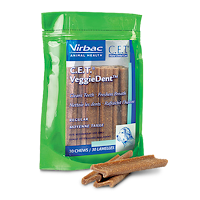
C.E.T.® VEGGIEDENT® Tartar Control Chews for Dogs

http://www.virbacvet.com/products/detail/c.e.t.-veggiedent-tartar-control-chews-for-dogs
These tasty vegetable-based chews have an easy-to-hold "Z" shape, and a tough, chewy consistency that dogs love.

Vegetable-based chew for dogs to help clean teeth and freshen breath.

Vegetable-based chews that work with a dog’s chewing action to freshen breath, reduce plaque, and decrease tartar formation.
  • Cleans teeth and freshens breath when chewed once a day by dogs.
  • Awarded the VOHC Seal of Acceptance for its ability to protect against tartar build up.
  • Independent study demonstrated significant plaque and tartar control in dogs fed 1 C.E.T.® VEGGIEDENT® Chew per day.1
  • Easy-to-hold Z-shape design and tough, chewy consistency.
  • Highly palatable vegetable-based chews for dogs. No animal-origin ingredients.
  • Available in 2 sizes; 4-inch strips for small dogs and 6-inch strips for medium and large dogs. Packaged 30 chews per bag.

Tuesday, January 17, 2017

Top 3 Dog Emergency Room Visits!!!

When most dog owners think of the emergency room visits, they think of broken bones or severe traumas. However, the most common reasons for emergency room visits are minor problems that just happen to flare up after-hours when regular veterinary offices are closed, leaving emergency rooms as the only available option for treatment.

The costs of these ER visits varies depending on the area of the country, what tests were done, how serious the case was, and whether the canine’s issue was treated in the hospital or as an outpatient.

Here are the three most common reasons dogs are brought to the ER, the average costs to treat them, and how you can prevent them. Please note that these are just estimates, and every hospital will have their own unique rates.
 
1. Vomiting

Hands down, this brings more canine patients into emergency clinics than any other condition. There are lots of causes for vomiting, ranging from serious metabolic diseases to dietary indiscretions. If you bring your dog into an emergency room for vomiting, and he leaves with symptomatic treatment and no tests, you’re likely looking at a bill of $140 to $204. With blood work, x-rays and medication to bring home, that cost jumps to $325 to $580, and
with blood work, x-rays, IV fluids, medication, and 24-hour hospitalization, you’re looking at a $480 to $855 bill.

You can help prevent vomiting in your dog by always feeding him a good quality diet (no table scraps!). Also, don't feed your dogs cooked or small bones, and resist giving them bones with lots of fat or raw meat. Prevent exposure to trash and any other objects that your dog may swallow. Finally, whenever you make any changes to your dog’s diet, do them gradually.

2. Diarrhea

Parasites, dietary changes or indiscretions, and metabolic diseases can cause diarrhea. Another common cause of diarrhea (and vomiting) is parvovirus. Commonly called "parvo," this virus can quickly weaken an otherwise healthy dog and is frequently fatal. Make sure your dog is properly vaccinated against parvo during their regular veterinary exam. An ER visit for diarrhea with symptomatic treatment and no tests will cost $100 to $188. With blood work, x-rays and medication to bring home, you’re looking at a $365 to $540
 bill, and with blood work, x-rays, IV fluids, medication, and 24-hour hospitalization, $480 to $795.

The best ways to prevent diarrhea in dogs is to prevent exposure to trash. When letting your dog outside, keep him confined to a fenced-in yard or on a leash to prevent him from getting into and eating things he shouldn't. Diet is also key. Be sure to consistently feed your dog good quality food, avoid cooked bones (especially those used to prepare people food), and keep his diet free of greasy or fatty foods. Again, make any dietary changes gradually.

3. Not Eating

The lack of an appetite is a common symptom and can be caused by just about every problem a dog can get, from very minor to serious. It also can be very scary for a dog owner, which is why it often leads to ER visits. With symptomatic treatment and no tests, the ER bill will be $120 to $165, with blood work, x-rays and medication to bring home, $390 to $570, and with blood work, x-rays, IV fluids, medication, and 24-hour hospitalization, $475 to $820.

Because there are so many possible causes (including infections, trauma, parasites, and various other diseases), this is one condition that is hard to prevent. The best thing you can do is to keep your dog safe and prevent exposure to problem items such as trash, medications, and toxins.

The Best Prevention

These three problems are very common and, unfortunately, they are likely to affect your dog at one time or another. And the costs for these ailments can add up — especially as some may require more than one visit or supervised time in the hospital for recuperation or to determine the underlying causes.

Do you have a separate savings account set up for your dog to cover ER visits and major veterinary expenses? If not, then you should consider pet insurance. It’s more affordable than most pet owners think, and with a number of different plans and options, you’re sure to find the right plan for your dog — and your budget. 

http://www.petplace.com/

Tuesday, January 10, 2017

Past and Present, Dr. Jon Dee ACVS Foundation Award Winner 2016 and Dr. Jessica Duhon

Past and Present, Dr. Jon Dee ACVS Foundation Award Winner 2016 and Dr. Jessica Duhon


Dr. Jon Dee, a 1966 Auburn Veterinary School graduate and a Diplomate of the American College of Veterinary Surgeons, received the ACVS’sFoundation Legends Award October 6 2016 in Seattle. Dr. Dee practices veterinary surgery at VCA Hollywood Animal Hospital. In his words, he “fixes broken puppy dogs.” In addition he has done research on orthopedic injuries of sporting dogs, contributed to journals and coauthored surgery books, and taught interns at VCA Hollywood Animal Hospital and as adjunct professor at both The Ohio State and the University of Florida Veterinary Schools. Dr. Dees’s other accolades include 1986s AVMA’s Practitioner Research Award and 1991’s AAHA Practitioner of the Year Award, Southeast Region.
 
Dr. Jessica Duhon, a 2014 Ross University School of Veterinary Medicine, is continuing in the family tradition like her grandfather Dr. Fredericksen and her second uncle Dr. Dee. Her grandfather Dr. I.C. Fredericksen and Dr. Jon Dee’s father, Dr. C.E. Dee started Hollywood Animal Hospital in 1947. Dr. Duhon went to University of Georgia for her undergraduate studies and initially was pre-nursing, but she knew her passion was with animal medicine. She went to Ross and completed her final year at Auburn University like her uncle. Dr. Duhon came to VCA Hollywood Animal Hospital for her internship and has continued on as a staff associate veterinarian.

I sat down with the two veterinarians in their office at VCA Hollywood Animal Hospital and chatted.
We spoke about the state of veterinary medicine. Dr. Dee was concerned about student debt. Dr. Duhon agreed and knew students at Ross who weren’t even able to graduate but were saddled with large debt. But we all agreed that you decide what you want, and none of us thought we were going into veterinary medicine for the money. 

Dr. Dee admitted that he wasn’t sure what he wanted to do when he was in college as an undergraduate in Auburn. His father told him to do whatever you want, but be the best at it that you can be. He decided on veterinary medicine when he decided there was nothing else he would like to do.
I asked Dr. Dee why his children did not go into veterinary medicine, and he didn’t know. The passion has to be within you and his niece, Dr. Duhon, seemed to have inherited the gene. Dr. Dee said that he would definitely choose veterinary medicine if he went back to his youth and had a choice to do it all over again. I am sure Dr. Duhon will feel the same way after she has been practicing for 50 years.

December Newsletter-http://www.browardcountyvma.com/


Wednesday, January 4, 2017

If Dogs Could Talk!!

Teaching dogs to talk is easier than you think

http://www.cnn.com/2016/05/18/tech/talking-dogs-georgia-institute-technology/

 Atlanta (CNN)If dogs could talk, Melody Jackson knows what they would say. Or at least, what she'd like them to say.
 
Jackson, an associate professor at the Georgia Institute of Technology, has developed technology that is giving dogs a voice, an ability she says is crucial for search and rescue, bomb detection and therapy dogs. The dogs wear vests equipped with sensors that can send either audible cues or text notifications to a smartphone.

Jackson earned her Ph.D. in computer science from Georgia Tech in 1998 and has trained assistance dogs for nearly 20 years. Now she's putting her two passions together. Jackson's research team, which includes professor Thad Starner and research scientist Clint Zeagler, has created high-tech vests for canines for a project called FIDO, which stands for "Facilitating Interactions for Dogs with Occupations." The program is sponsored by The National Science Foundation and also the Defense Advanced Research Projects Agency, better known as DARPA.

The vests have been approved by Jackson's 8-year-old border collie, Sky.

"He actually has helped us design a lot of these sensors, by telling us what works and what doesn't work," she says. "So, he's sort of our first line of testing before we go out to the rest of the world. He's a very critical part of our design team."

The vest has side sensors that the dogs trigger with a bite or a nudge of their nose. They're trained with toys, identifying between a Frisbee or a ball, and telling their handler which is which. Jackson explains this is an example of a "discrimination task" that can be translated to more important tasks, such as bomb detection, where the dog would tell his handler what explosive he or she has scented.
Jackson has been observing bomb dog training in hopes of putting her vests to the test with canines on patrol with soldiers on the battlefield.

"A bomb-sniffing dog has pretty much one alert that says, 'Hey, I found an explosive." But that dog knows what explosive is in there. ... They know if it's something stable like C4 or something unstable and dangerous like TATP that needs to be handled carefully," Jackson says. The problem is "they have no way to tell their handler."

Jackson and her research team have also developed a medical alert vest that allows a dog to find a missing or trapped person, activate a sensor, and let that person know that help is on the way. This task could be instrumental during an earthquake or disaster rescue where a trapped or injured person is in need of assistance. This vest is being beta tested by a real service dog team in California, Jackson says.

Georgia Tech is also working to develop a vest that allows the handler to track the dog wearing it. When the dog finds its target, the dog activates a sensor that sends GPS coordinates back to the handler. The dog then tells the person in jeopardy that help is on the way, and the rescue canine does not have to leave the victim's side.

Jackson believes there are personal applications for this technology as well.

"What if that dog could reach around and pull a tab on its vest and call 911 with your GPS location, and text your husband: 'By the way she's at Starbucks on Fifth and Spring, and she's having a seizure right now.' Your husband would know immediately that 911 is on the way."

The vest could be helpful for a person who cannot speak or a hearing-impaired person. The dog could tell others to get help with the phrase "Excuse me, my handler needs your attention." Jackson's dogs are also trained to discriminate between a doorbell or a fire alarm, and to activate the appropriate sensor on their vest to text a message to the handler's cell phone.

"A hearing dog helps someone who's deaf, so they alert to things like the doorbell ringing or the baby crying or someone calling your name," Jackson says. "What they'll do is nudge their owner and take them to the source of the sound. ... What if that sounds is a tornado siren? That's just in the environment. The dog has no way to lead you to the source of that sound."

Jackson says one of her dogs was able to understand the vest and its capabilities in just 27 seconds. She believes any trainable dog would be able to pick up on the technology very quickly.

Friday, December 2, 2016

In Home Lymph Node Exam

In Home Lymph Node Exam:

An ounce of prevention is worth a pound of cure. Unfortunately, many diseases pets suffer from go undetected until progression is severe enough to produce harmful clinical signs -- and an equally scary hospital bill. In the interest of saving their pets (and their pocket books!), owners often ask me for simple measures they can take to identify early signs of disease. I give them two words: Lymph. Nodes. While there’s no way to completely avoid every health problem out there, frequent lymph node exams can tip owners off to subtle changes in their pets’ health. Not only do these exams offer owners the chance to detect inflammation, infection, and cancer, they also encourage owners to become more familiar with what’s normal for their animals.

So you’re probably wondering what lymph nodes are and how you can examine them. Most people are familiar with blood vessels and nerves, the highways of blood and synapses, respectively, that keep our bodies oxygenated and integrated. Less familiar are our lymphatic vessels, which transport certain types of immune cells. If lymphatic vessels are highways, lymph nodes are the cities they connect. These metropolises are masses of tissue that generate certain immune cells and serve as epicenters of immune cell activity. They are located throughout the body and named for their anatomical locations; peripheral lymph nodes may be felt externally, while internal lymph nodes are deep within the body. Peripheral lymph nodes occur in right/left pairs. Veterinarians assess these lymph nodes as part of their routine physical exams, however, owners can learn to do this at home on a more frequent basis. The lymph nodes that should be routinely felt on both sides of your pet are: the submandibular nodes, the prescapular nodes, the axial nodes, the inguinal nodes, and the popliteal nodes.

How you do it: If you aren’t fond of anatomy jargon, you aren’t alone! You can see a demonstration of each of these sites in the labeled images. To assess a lymph node, roll it between your thumb and index finger. For pets that are overweight you may have a tricky time locating the lymph node, as they are often surrounded by fat. Lymph nodes are kidney shaped and vary in size by species and breed, but generally small breed dogs have chickpea-sized nodes, medium breeds have pecan-sized nodes, and large breeds have brazil nut-sized nodes. Outside of these relative ranges, lymph nodes may be considered enlarged and you should have a veterinarian assess your pet. 


What it means: Lymph nodes become enlarged when they generate more immune cells and increase the flow of lymphatic traffic. This is associated with swelling and heat at the site of the lymph node. It may be happening as a response to infection or, rarely, a cancerous change. Your veterinarian will take a sample from the lymph node using a needle and analyze it under a microscope. A special veterinarian known as a Veterinary Clinical Pathologist is often consulted to interpret the findings. Lymphoma, cancer of the lymph nodes, is the most common cancer found in dogs and often presents with enlarged nodes. Additionally, lymph nodes are often sites of early spread for other types of cancer. Early detection is very important! Providing your pet with diligent exams increases their chance of early disease detection and early treatment!


Dr. Matthew Schexnayder


Friday, October 21, 2016

Free Pet Photo with Santa!!!

FREE PET PHOTOS WITH SANTA!!!!!!!!

Now in its fifth year, St. Nick's pre-holiday route has VCA HAH as a permanent stop. Maybe it is all of the cuddly faces!!

Please join us on Saturday, December 17th with your darling dog and your cherished cat for a FREE photo with Santa!

A photographer will be on hand to take the photos and print them out while you wait.

WHO/WHAT: Pose your furry baby with the big bearded one!

WHEN: Saturday, December 17, 2016
9:00 a.m. - 12:00 p.m. 

WHERE: VCA Hollywood Animal Hospital
Annex Building
2864 Hollywood Boulevard, one block east of I-95
Hollywood, Florida 33020
954.920.3556

HOW: This is a FREE event. People and pets can just stop by!!
Visit our Facebook page to see the fun we have had with this event over the years and the hilarity that ensues when you get Santa suited up with a LOT of animals.

This is also the final day of our Broward Meals on Wheels Food Drive for Pets! Check out our blog for more details about this month long drive and how you can help!!


https://hollywoodanimalhospital.blogspot.com/2016/08/broward-meals-on-wheels-pet-food-drive.html

Tuesday, October 18, 2016

Drop off site for VCA Broward Meals on Wheels for Pets Food Drive !!!!!!!

 BROWARD MEALS ON WHEELS FOR PETS FOOD DRIVE


  VCA Animal Hospitals 

 November 12th through December 17th


WHEN:

November 11th- December 17th, 2016

HOW

Just stop by with a donation of canned, dry or dehydrated food for cats or dogs.


ADDITIONAL INFORMATION:

VCA  Animal Hospital have a solid reputation for offering the very best in veterinary medicine as well as the latest technological advances and therapies. We believe that giving back to the people that supports us is paramount. 

Broward Meals on Wheels for Companion Animals started when volunteers began to notice clients sharing their meals with their pets. Senior on a restricted budget can have a difficult time meeting their own needs and often the needs of their companion animals can be neglected. With only the support of volunteers and donation this organization provides delivery of food for these loyal pets once a month to clients of BMOW. For more information visit www.bmow.org.


This year, donations for food can be made at VCA Hollywood as well as 
WHERE: 
Pet Supplies Plus
Sheridan Plaza

4923 Sheridan St

Hollywood, FL 33021
954. 985.3400

M-Sat 9a-9p

Sunday 10a-7a
3000 Stirling Rd # 132, 
Fort Lauderdale, FL 33301
(954) 639-4173


VCA Aventura Animal Hospital

19101 Biscayne Blvd
Aventura, FL 33180
(305) 933-3647


Thank you to our local partners for providing additional collection site for our BMOW Pet Food Drive!!! 

Click here to see the results of last year's food drive!!